By Derek Sheehan
Montana manufacturers in 2025 grappled with the economic pressures of elevated input costs, persistent workforce challenges, and trade uncertainty. These forces are reshaping the sector, creating ongoing challenges for manufacturers throughout the state.
The inflation reality
Input prices tell a clear story. Except for petroleum and coal products manufacturing, with a producer price index that sits just 5% above August 2018 levels, Montana’s main manufacturing sectors face substantially higher input costs. Producer prices across key sectors have climbed 20% to 48% compared to seven years ago, with fabricated metal products, wood and lumber, and food manufacturing experiencing the largest increases, according to Bureau of Labor Statistics data.
These cost pressures affect Montana manufacturers’ bottom lines each month. While the rate of inflation has slowed, prices remain elevated. Manufacturers face higher costs just as consumers continue to pay more than they did at the grocery store. Unlike the pandemic period, manufacturers now face these costs without a demand boost to help absorb them. Instead, consumers are already stretched by persistent service inflation, leaving manufacturers with less room to raise prices.
The persistent workforce challenge
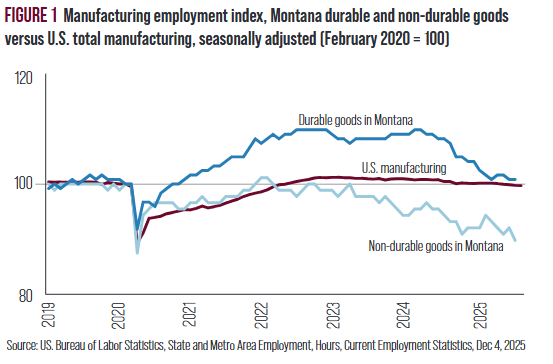
Employee retention and workforce skills remain a challenge. Workforce issues have been cited by a majority of Montana’s manufacturers for much of the past decade. Montana’s manufacturing employment grew strongly following the pandemic, outpacing the national recovery. Since August 2022, however, employment change represents a realignment with broader national trends. Non-durable manufacturing (goods that are consumed quickly, like food, beverages, and fuel) has lost roughly 1,100 jobs while durable goods (products like cars, large appliances, electronics, and furniture) shed approximately 800 positions, about half those losses concentrated in wood products manufacturing.
Economic uncertainty
Trade uncertainty adds another challenge for Montana manufacturers. According to BBER’s 2025 Montana manufacturing survey, 53% of durable goods manufacturers and 74% of non-durable manufacturers rely on imported inputs. Manufacturers face narrowing margins with constrained options: absorb the costs and reduce profitability or raise prices in markets where customers may look elsewhere.
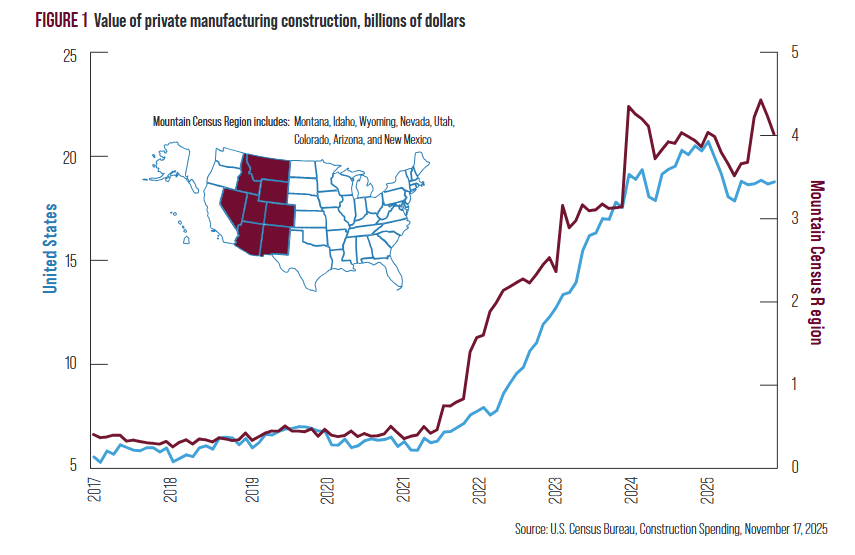
The long-term response requires substantial capital investment, developing domestic supply chains, and deploying automation technologies to maintain competitive pricing. These transitions take time, especially for industries with complex supply chains like computer and electronic products, aerospace, and agricultural machinery. Yet manufacturing construction data suggests manufacturers are hesitating – construction spending in the Mountain Region and nationally has been flat or declining for much of the last year.
Montana’s manufacturing sector demonstrated exceptional resilience during and directly after the pandemic. The Federal Reserve’s recent 0.25 percentage point rate cut offers meaningful relief for the state’s manufacturers that are more interest-rate sensitive than their national counterparts. The investment environment going forward will be dictated by the pace of additional Fed rate adjustments and the structure of any tariff-relief mechanisms for affected industries, and consumers. At the time of this writing, tariffs themselves are in question as the Supreme Court has not yet ruled on presidential tariff authority. The specifics of these outcomes will map the investment and trade environment that the state’s manufacturers must navigate.
Regardless of how these conditions evolve, manufacturing construction investment will be a key indicator of the sector’s ability to adapt. With many Montana manufacturers serving regional or domestic markets rather than export markets, maintaining competitiveness means finding ways to offset high input costs and workforce challenges through capital and labor productivity improvements. Whether manufacturers can successfully navigate this environment will depend largely on their capacity to invest in new facilities, equipment, and technologies that truly make more with less labor.
Derek Sheehan is an economist at the Bureau of Business and Economic Research at the University of Montana.