By Derek Sheehan
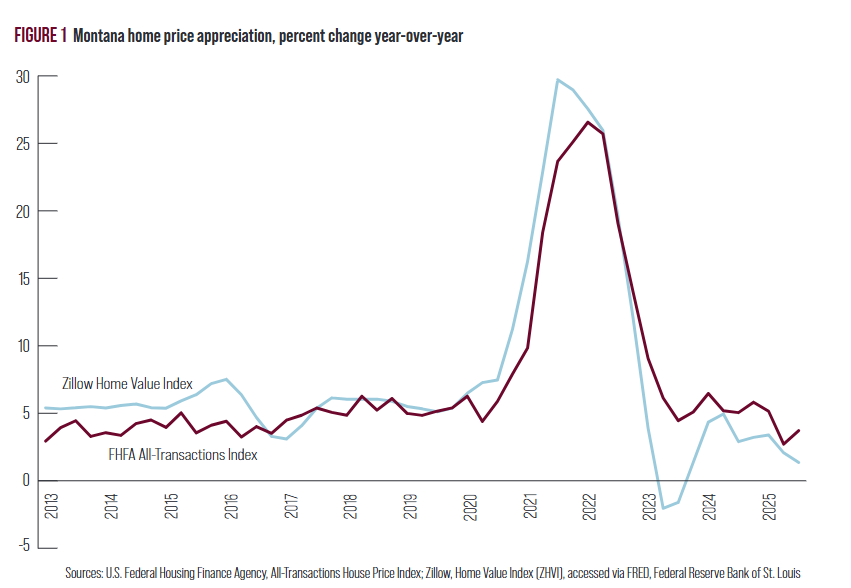
Montana’s housing market has shown few signs of thawing. The number of homes sold has remained essentially flat year-over-year since 2023. Despite mortgage rates declining slightly after peaking above 7% in early 2025 and settling into the low 6% range, this modest improvement has not been enough to bring buyers back to the market. Metrics like median days on market are gradually creeping upward, signaling persistent hesitation on both sides of the market. To understand the current environment, it helps to look at Montana’s historical price growth. From 2013 to 2020, home prices in Montana rose about 5% year over year.
The pandemic, however, revealed underlying supply pressures in many Montana markets. Different parts of the state experienced upwards of 75% home price appreciation from mid-2020 to mid-2022. Under more normal interest rates and net migration, the market returned to that 5% annual price growth in 2024. However, 2025 has seen further coolingムboth the Zillow and FHFA home price indexes show statewide appreciation edging slightly below the historical range, approaching zero.
When statewide appreciation approaches zero, some markets must be experiencing outright price declines. That’s exactly what Montana’s regional data reveals. Price appreciation has slowed substantially in the state’s hottest markets like Kalispell and Whitefish, while more affordable markets like Helena, Butte, and Great Falls are experiencing similar cooling. Bozeman’s single-family market saw year-over-year price declines last year, with Missoula and Hamilton likely to join the downward-price correction club.
“Price appreciation has slowed substantially in the state’s hottest markets like Kalispell and Whitefish, while more affordable markets like Helena, Butte, and Great Falls are experiencing similar cooling.”
The rental market has seen vacancies tick upward from a historically tight 2.5% in late 2022 to 4.3% in 2025, offering some breathing room for Montana’s renters. This improvement stems from multifamily construction in 2021-2022. Markets like Kalispell and Bozeman have seen rents stabilize, while others like Missoula and Great Falls have returned to more normal 2-4% annual increases rather than the 15-30% experienced during the pandemic, reflecting a similar return to normal seen in Figure 1.
Looking forward
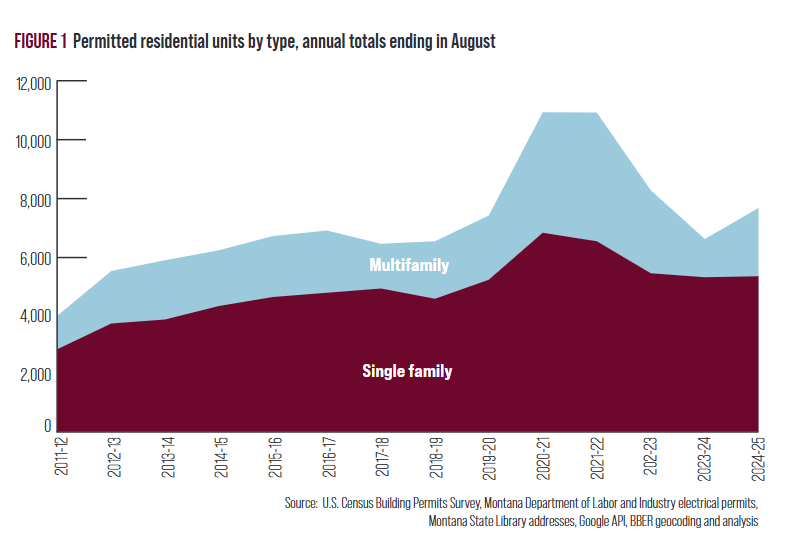
The 2026 story will be shaped by three forces: regional price corrections, construction trends, and property tax shifts. To capture statewide construction beyond traditional building permits, BBER compiles and geocodes electrical permit data from the Montana Department of Labor and Industry (Figure 2). This reveals construction across all jurisdictions and unincorporated areas that do not require building permits.
While construction has moderated from pandemic-era peaks, both single-family and multifamily permitted units remain 10-15% above pre-pandemic baselines. Multifamily construction dropped sharply in 2023-2024 but rebounded in the year ending August 2025. Whether this signals a sustained pivot toward density or simply a temporary recovery will be critical for long-term rental affordability as population growth resumes.
Also shaping the supply picture are substantial property tax shifts from House Bill 231 and Senate Bill 542. Second homeowners and short-term rental owners face property tax increases, with early Montana Department of Revenue projections in May 2025 estimating an average 68% rise over the two years. Higher-amenity areas like Whitefish, Big Sky, and the Flathead Valley would be expected to see the most impact as second-home owners reassess their investments, potentially converting properties from seasonal to year-round use or putting them on the market.
“As Montana’s baby boomers age,
homes will come available as
they downsize or exit
the market.“
Demographic shifts add another layer of uncertainty. As Montana’s baby boomers age, homes will come available as they downsize or exit the market. In warm markets like Bozeman and Missoula, this may simply slow price growth. In cold and cool markets, these homes become vacancies.
Together, these forces paint a complex picture for 2026. The cool weather of 2025 has brought Montanaユs housing market closer to historical norms, but challenges remain. While regional price corrections, property tax changes, and demographic transitions may provide relief, Montanaユs housing affordability ultimately depends on one factorムbuilding enough units to meet the demand of its current and future residents.
Derek Sheehan is an economist at the Bureau of Business and Economic Research at the University of Montana.