By Jeffrey Michael
Montana’s economy continues to decelerate from its pandemic-era surge, and while overall growth is slower, the economy is far from stagnant. Average incomes are rising as higher-wage professional service and technical jobs continue to grow, tourism is leveling out, and many traditional natural resource-based industries are becoming a smaller part of the state’s overall economic mix. Housing affordability is clearly impacting population growth, and labor scarcity continues to be a challenge for many businesses.
Our top story of 2024 was that Montana’s population growth had fallen to a 0.52% rate, the lowest in 22 years after experiencing record growth just a few years earlier. Because of the federal government shutdown, we do not have official Census estimates for 2025 growth, but preliminary quarterly Bureau of Economic Analysis (BEA) population estimates are an alternative data source.
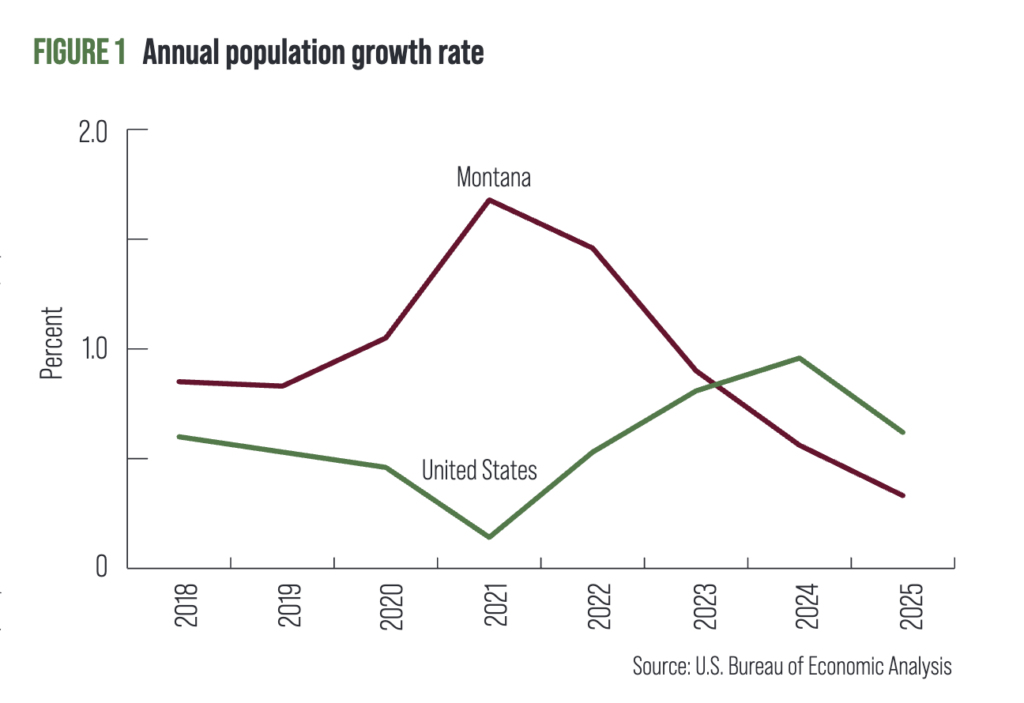
According to the BEA data, Montanaユs population growth slowed to a crawl in the first two quarters of 2025 and only grew by 0.33% between May 2024 and May 2025 (Figure 1). U.S. population growth also declined in early 2025 as the immigration surge ended, but Montanaユs decline is more likely the result of its continued housing affordability challenge that depresses net domestic migration.
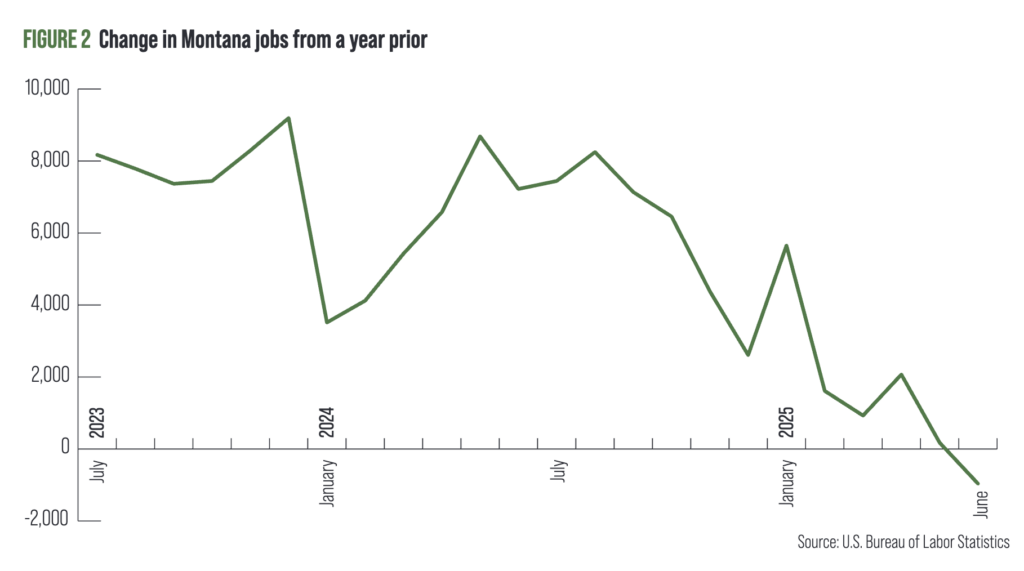
Job growth in Montana has also declined substantially, but the unemployment rate has remained at or below 3% for the past year. Figure 2 displays the most recent jobs data for Montana, showing that June was the first month since the pandemic that total jobs in the state had declined compared to the previous year. The decline in jobs reflects a few sectors that clearly contracted, such as the loss of over 900 jobs in natural resources and mining, and declines of nearly 700 federal jobs and 500 manufacturing jobs. Decreases of about 800 jobs in leisure and hospitality and other services could reflect a shortage of workers in these lower-paying sectors as summer seasonal hiring was less robust than in the past. These job losses were offset by gains in high-paying fields, including nearly 1,600 health care jobs, 900 jobs in professional and business services, and over 200 jobs in the information sector.
On a more positive note, the same data that shows Montana jobs decreased over the year ending in June 2025 also shows that the average wage of Montana jobs grew by 5.4% over the same period ミ the fastest wage growth of any state and far above the national average wage growth of 3.4%. This is partially driven by the shift in the economy toward higher-paying sectors, although it should be noted that wage growth was significant across all industries. For example, average wages in leisure and hospitality grew by a robust 5.7% even as overall jobs in the industry declined, possibly reflecting competition for scarce workers and increased hours worked.
Performance of Montana’s Industries and Income
Total inflation-corrected (real) personal income grew by a strong 3.2% between the second quarter of 2024 and 2025, an increase from 1.8% growth the previous year. This is an impressive performance in total income growth when considering the weak population growth discussed earlier. Some of this overall income growth is due to a recovery in farm earnings and an increase in government transfer payments, but growth was still a solid 2.6% when focused on real nonfarm earnings.
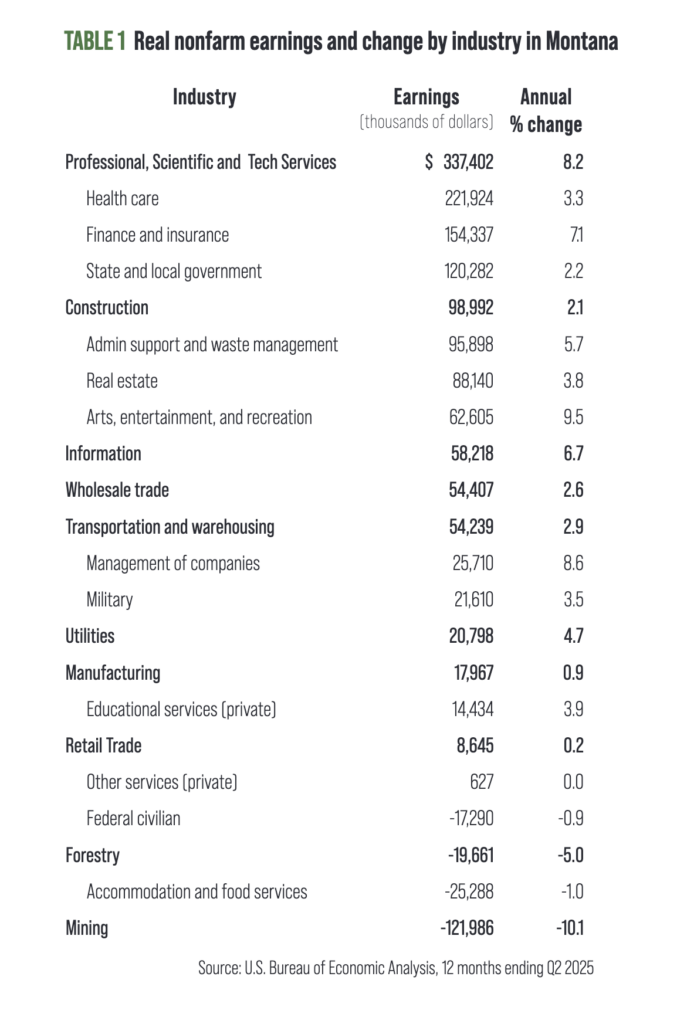
Table 1 shows inflation-adjusted earnings growth by industry in Montana, a good measure of the scale and structure of economic growth.
Continuing a multiyear trend, professional, scientific, and technical services is powering Montana’s economy with over $337 million in real earnings growth in 12 months, an impressive 8.2% growth rate followed by expansion in the large and steadily growing health care sector, which added over $220 million in earnings over the year. Finance and insurance was the third-highest contributor, as improved net interest margins helped banking profitability. Construction grew by justunder $100 million (2.1%), which is somewhat slower than recent years, and real estate earnings grew again after declining the previous year.
Four sectors saw a decline in real earnings. Two natural resource sectors, mining and forestry, added another negative year on top of declines in 2024, with mining seeing a $120 million decline. Two other sectors posted declines for the first time in many years. Federal civilian earnings declined by over $17 million in response to federal job cuts, and accommodation and food services posted a surprising $25 million decline in earnings that parallels a decrease in jobs discussed earlier.
Looking Ahead to 2026
Montana’s economy enters 2026 with mixed prospects. The stateユs emerging scientific and technical sectors seem poised for further growth. The bioscience, pharmaceutical and health care sectors could get a boost as Montana implements its nation leading right-to-try law that has attracted interest from firms interested in new opportunities to market and further develop experimental treatments. The mining sector that has seen steep losses in recent years should see improvement as copper and palladium prices improve and regulatory changes support growth in coal production.
There are also areas of concern. Montana has always had a concentration of federal jobs due to its expansive federal lands, but federal layoffs are ongoing and the full extent of these will come into clearer focus as we move into 2026. Big changes in U.S. health care create uncertainty for this large and critical industry. The tourism and hospitality sector is slowing down as budget conscious travelers may continue to show restrained spending even as they continue to visit Montana in large numbers. Residential construction is another area to watch as building permits have shown a slight decline in 2025, and slowing population growth and property tax changes that increase the costs of owning a second home in Montana could weigh on demand.
Finally, 2026 may be the year that the data center boom that has been propelling business investment across the U.S. finally hits Montana in earnest. While a large data center project planned near Great Falls was recently canceled, other large projects outside Billings and Butte continue to move through the planning stages and could be under construction in late 2026. Other projects are rumored to be in the works. The real scale and timing of data center investment is highly uncertain, and large economic impacts may not be felt in Montana until 2027.
Overall, Montana’s economy is likely to grow modestly in 2026, similar to 2025. While overall growth rates may change little, it is likely to be an eventful year as the economy continues to respond to rapid technological, demographic, and political changes.
Jeffrey Michael is director at the Bureau of Business and Economic Research at the University of Montana