By Derek Sheehan and Jeffrey Michael
Over the past year, Montana’s economic growth has decreased,
and the slowdown has been most notable in jobs.
For the past decade, Montana’s economic growth has been led by two counties that have experienced some of the fastest economic growth in the United States.
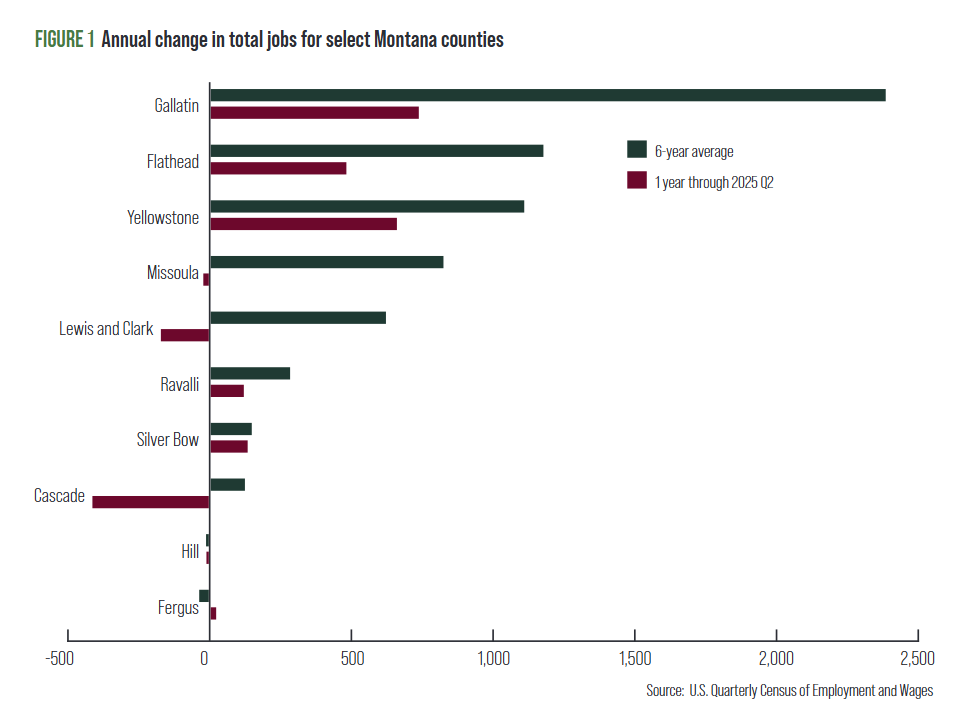
As the gateway to popular national parks Glacier and Yellowstone, Flathead and Gallatin counties have experienced the largest population increases in Montana in the past five years. These counties have also experienced rapid growth in the construction and hospitality sectors, as well as expanding tech sectors that have fueled new jobs in professional and technical services and advanced manufacturing. Over the past six years, Gallatin County job growth has averaged over 4% annually, and Flathead County has averaged nearly 3% job growth. To put those numbers in perspective, total U.S. employment grew just over 5% over the entire six-year period from Q2 2019 to Q2 2025, an annualized rate less than 1%, meaning these two Montana communities were growing at three to four times the national pace.
Other areas of Montana experienced more moderate rates of growth over this period. For example, Missoula and Yellowstone counties – the other two counties in Montana with populations over 100,000 – grew at about half the pace of Gallatin and Flathead counties but still exceeded the U.S. average.
Over the past year, Montana’s economic growth has decreased and the slowdown has been most notable in jobs. As of June 2025, the most recent data available from the Quarterly Census of Employment and Wages, the majority of Montana’s counties (35 out of 56) had experienced a decrease in jobs over the previous 12 months. The fastest-growing counties of Gallatin and Flathead have seen their growth rates fall to less than half of their six-year average, among the largest decreases in the state. However, these two counties, along with the state’s most populous county – Yellowstone, home to Billings – have all continued to add jobs faster than other areas of the state. In contrast, Missoula, Lewis and Clark, and Cascade counties have experienced an overall decrease in jobs over the most recent 12 months. Reductions in federal government employment are a common factor in Missoula, Lewis and Clark, and Cascade counties – all counties with the largest concentrations of federal jobs.
Gallatin County
Gallatin County remains Montana’s growth leader but has cooled considerably from pandemic-era highs. After adding about 2,300 jobs annually from 2022 to 2024, growth has slowed to just over 700 in the past year. Housing affordability has become a major constraint to growth, slowing the pace of in-migration. Despite the slowdown, the county continues to benefit from its tech sector presence and strong Yellowstone National Park tourism, creating growth across much of the service sector. The Bozeman area still leads the state in job creation but has experienced a decline of a few hundred construction jobs in 2025 after large expansions in recent years, indicative of the slowing economy.
Flathead County
Growth around Kalispell, Whitefish, and Columbia Falls continues, driven by strong in-migration from other states, though the pace has fallen substantially from pandemic highs. Accommodation and food services has about 180 fewer employees in 2025. Rather than a decrease in demand, the recent decline in hospitality jobs could reflect workforce challenges including an aging labor pool. Flathead County also stands out as a region where the manufacturing sector has continued to weather hard times relatively well. The wood products sector has been resilient in Flathead County in contrast to declines in other parts of the state, and advanced manufacturing of computer components has grown. Health care and construction, which experienced explosive pandemic-era growth, have returned to more normal growth rates as population growth has also returned to more normal growth.
Missoula and Ravalli Counties
In 2024, Missoula County lost two large wood products manufacturing facilities in the closures of Pyramid Mountain Lumber in Seeley Lake and Roseburg Forest Products Missoula particleboard plant. These closures have been followed by the 2025 shutdown of the Edge wood products facility in Bonner, resulting in the loss of about 400 wood products manufacturing jobs in less than two years. Federal employment has decreased by about 120 jobs as of June 2025, with more losses expected as data for the second half of 2025 is released and the full impact of the Forest Service Region 1 headquarters closure and cutbacks to the Rocky Mountain Laboratories in Hamilton hit. Combined with a drop of over 500 employees in accommodation and food services, these losses represent a significant blow to the region’s economic base. However, health care, construction, and the information sectors have been a bright spot in the local employment picture. Health care is a regional strength and has added about 400 jobs in the past year across the two counties. Providence St. Patrick Hospital and Community Medical Center provide economic stability for Missoula’s service sector, while the continued expansion of Bitterroot Health has delivered substantial employment growth in Ravalli County.


Yellowstone County
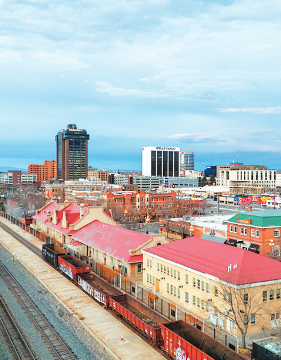
Billings remains Montana’s largest city, though employment growth has slowed after the pandemic recovery. The deceleration is largely due to a decrease in construction (down 326 jobs in 2025) and the broader service economy, including transportation and warehousing. Health care continues as a major growth sector, as evidenced by Intermountain Health St. Vincent’s June 2025 groundbreaking on a nearly $1 billion facility. Health care employment jumped by 765 jobs over the past year. The county’s three oil refineries remain important economic anchors, although recent declines in mining in nearby counties have had some ripple effect in the Billings area. Yellowstone County is performing below the state’s fast-growing western counties but maintains its role as an energy, finance, and health care hub for much of Montana.
Lewis and Clark County
As Montana’s capital, Lewis and Clark County has historically relied on stable government employment of about 11,000 workers while experiencing moderate growth. After very strong growth in 2024, Lewis and Clark County has experienced a modest decline in jobs during the first half of 2025, with the biggest declines in the past year being a loss of about 195 government employees and another 124 in accommodation and food services. Despite these losses, health care has demonstrated consistent expansion. Although not matching the growth pace of Gallatin, Yellowstone, and Flathead counties, Lewis and Clark County maintains a stable economic base and relative affordability compared to Montana’s fastest-growing regions.
Cascade County
Great Falls and Cascade County face demographic headwinds, with both migration and natural population change turning negative after about three years of positive net-migration. Unlike counties with concentrated losses in specific sectors, Cascade County experienced broad-based employment declines across health care, government, retail trade, accommodation and food services, manufacturing, and other services. As a regional service center for the Golden Triangle counties to its north, Cascade County may be experiencing some spillover effects from low crop prices in these agricultural counties. In 2025, Cascade County has seen some expansion in construction employment and professional and business services, offsetting some declines in other areas. The Great Falls area is characterized by uncertainty over multiple very large projects that could quickly change the trajectory of what has been the slowest growing of the state’s main economic centers. The largest of these is Project Sentinel, a massive $150 billion project to modernize the nation’s ICBM nuclear arsenal. The project has three locations in the United States, including one surrounding Great Falls and Malmstrom Air Force Base.
However, Project Sentinel has been delayed and is said to be undergoing some replanning as a town hall to update the community was canceled in August 2025. In addition, a massive $1 billion data center outside Great Falls that was announced in early 2025 was canceled by its developer, Atlanta-based Ardent TAC Data Center, in November. However, Great Falls remains an attractive location for data-center development, and it would not be surprising to see new data center projects given the nationwide expansion of this sector. The Great Falls Little Shell Resort was announced about a year ago and would bring a large hotel, casino, water park, and an arena for large events, but the construction timeline is uncertain. While Cascade County has had the largest decline in employment in the state over the past 12 months, big changes could be in store with major new projects in the planning stages.
Butte-Silver Bow
Butte-Silver Bow’s economy continues its long transition from its mining heritage. Mining employment remains highly concentrated in Silver Bow County compared to the nation and has provided a stable core for the regional economy over this period. Government employment, which had been growing, reversed course with substantial losses driven by state budget pressures and local government constraints. Health care has reemerged as a leading employment sector and is on a substantial upswing, anchored by St. James Hospital’s expansion as part of Intermountain Health. Construction employment is up modestly and could see a substantial increase in late-2026 if two large data centers break ground according to current plans.
Fergus County
Lewistown has long been a beacon of stability in central Montana, and this reputation played into very significant economic news: VACOM, a German vacuum technology manufacturer, opened its first U.S. manufacturing facility in Lewistown in July 2025. VACOM’s leadership cited Lewistown’s stable community and quality of life as key factors in their location decision. The facility currently employs 12-25 workers with potential to expand up to 200 jobs over the next two years, representing a substantial bright spot for manufacturing in central Montana.
Hill County
Hill County’s economy centers on agriculture, rail transportation, and border activities. BNSF Railroad and U.S. Border Patrol remain anchor employers. Three significant employment sectors (government, wholesale trade, transportation and warehousing) saw substantial losses this past year, likely reflecting broader softness in rail freight volumes and cross-border trade activity. However, employment improved across most other sectors after years of flat growth, with strong gains in services, particularly health care, and continued growth in construction.
Derek Sheehan is an economist at the Bureau of Business and Economic Research at the University of Montana.
Jeffrey Michael is director at the Bureau of Business and Economic Research at the University of Montana.