Study Finds Social Media Now a Leading News Source for Montanans
Note: The Bureau of Business and Economic Research conducted the 2025-2026 Sources of News Survey that was commissioned by the Greater Montana Foundation. The following press release was written by the Great Montana Foundation.
Read the full BBER article here.
For full BBER survey results and slide deck, visit our website here.
May 28, 2026 — Helena, Mont. — A new study released by the Greater Montana Foundation, the organization dedicated to encouraging communication on the issues, trends and values important to Montanans, reveals startling new trends in Montanans’ attention to news and how they consume news and information.
According to the 2025-2026 Sources of News Survey, commissioned by GMF and conducted by the University of Montana Bureau of Business and Economic Research, Montanans’ attention to news is decreasing, becoming a more passive experience. And age and political party affiliation are increasingly determinant factors in which news sources are consumed and trusted.
The statewide, random-sample survey was conducted in the winter of 2025-2026 and follows the 2015, 2016 and 2019 GMF Sources of News surveys. This new survey, the first in the post-COVID era, asked Montana adults about their news consumption habits, trusted news sources and issues of importance. The survey has a sampling error rate of +/- 6%.
“While the study shows that local news remains important to Montanans, more people are now receiving news through social and digital platforms where information is delivered to them rather than actively sought,” said Nicole McCleskey, partner at Public Opinion Strategies, a national public opinion research firm that provided analytical assistance for the GMF study. “As algorithms increasingly shape what people see, news consumption can become more passive and reinforce echo chambers that limit exposure to differing perspectives and sources of information.”
The study finds that Montanans are increasingly consuming news as a passive experience, with 67% of adults saying they are more likely to “read or listen to the news that is delivered to you” as compared to 33% who “search out news that interests you.” Adults with a high school education are more likely to be passive news consumers, with 82% listening or reading news that is delivered to them, compared to 56% of those with a college degree.
The survey also reports that Montanans’ attention to current events has steadily dropped since 2015, with those who follow the news “very closely” dropping from 23% in 2015 to 19% in 2025-2026. Attention to news is eroding most significantly among younger adults, with 51% of Montanans ages 18 – 34 saying they follow the news “very” or “somewhat” closely, compared to 85% of adults age 65 and older.
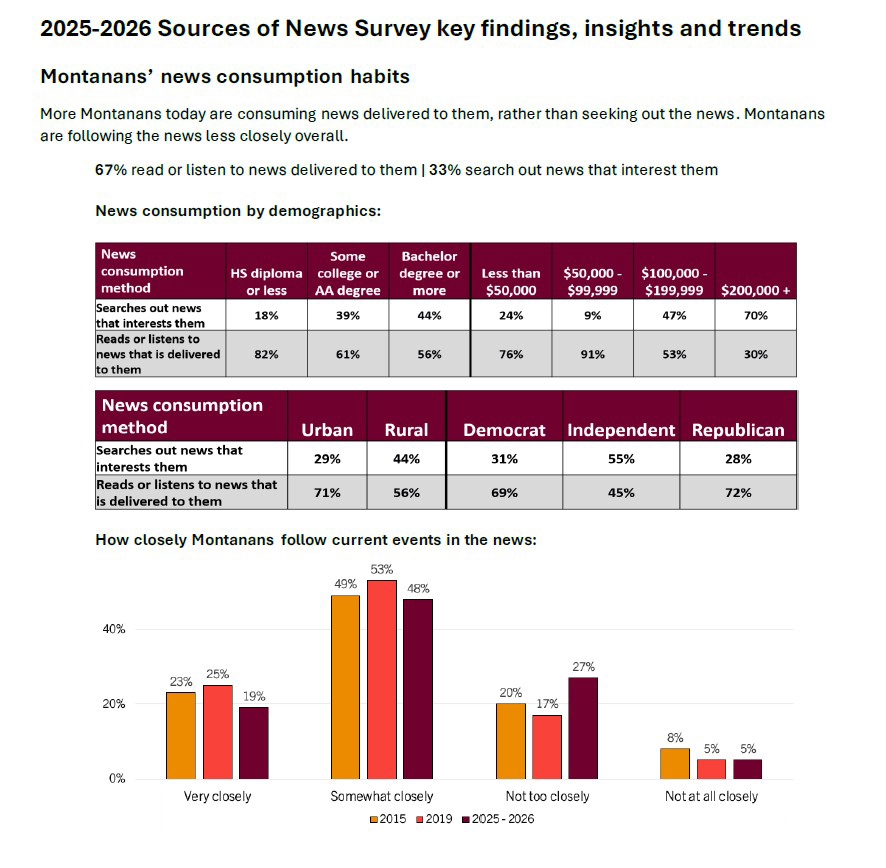
When asked if they use social media as a news source, 71% of Montanans said they use social media to access news and information, compared to 47% in 2019 and 34% in 2015.
Use of social media as a source of local news now matches local television and newspaper consumption and exceeds radio. Local news continues to be at least somewhat important to Montanans, with 82% of the respondents saying that they find local news “absolutely,” “mostly” or “somewhat” important.
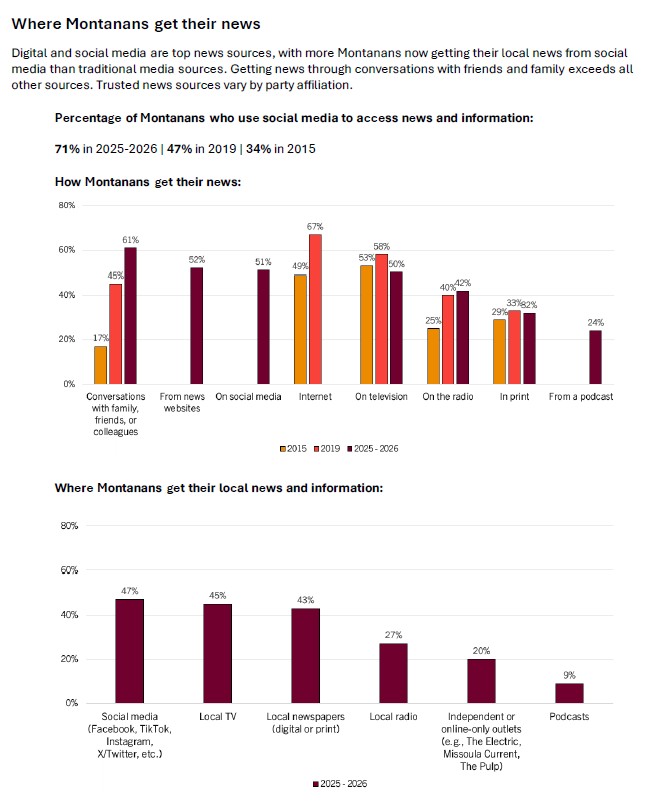
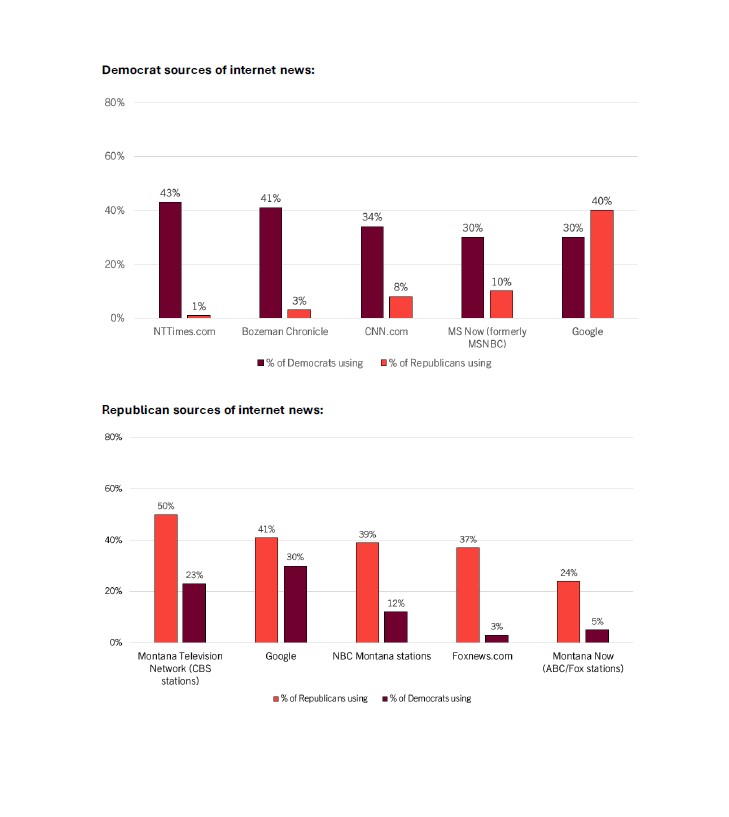
Partisan preferences in news consumption and trustworthiness divided survey respondents. When asked what specific news source they trust most, Republican respondent sources included a mix of local and national news sources, including Montana Television Network (CBS), Google, NBC Montana, FoxNews.com and Nonstop Local (ABC/Fox). Democrat respondents’ trusted news sources included NYTimes.com, Bozeman Chronicle, CNN.com, MS NOW (formerly MSNBC) and Google.
“Montanans continue to value local news, but this study highlights how dramatically the ways people access and engage with news have changed over the last decade,” said Ed Johnson, chair of the Greater Montana Foundation Board of Trustees. “These findings underscore the importance of informed civic dialogue and seeking trusted journalism from a variety of sources at a time when news consumption is increasingly shaped by digital platforms, political polarization and passive information habits.”
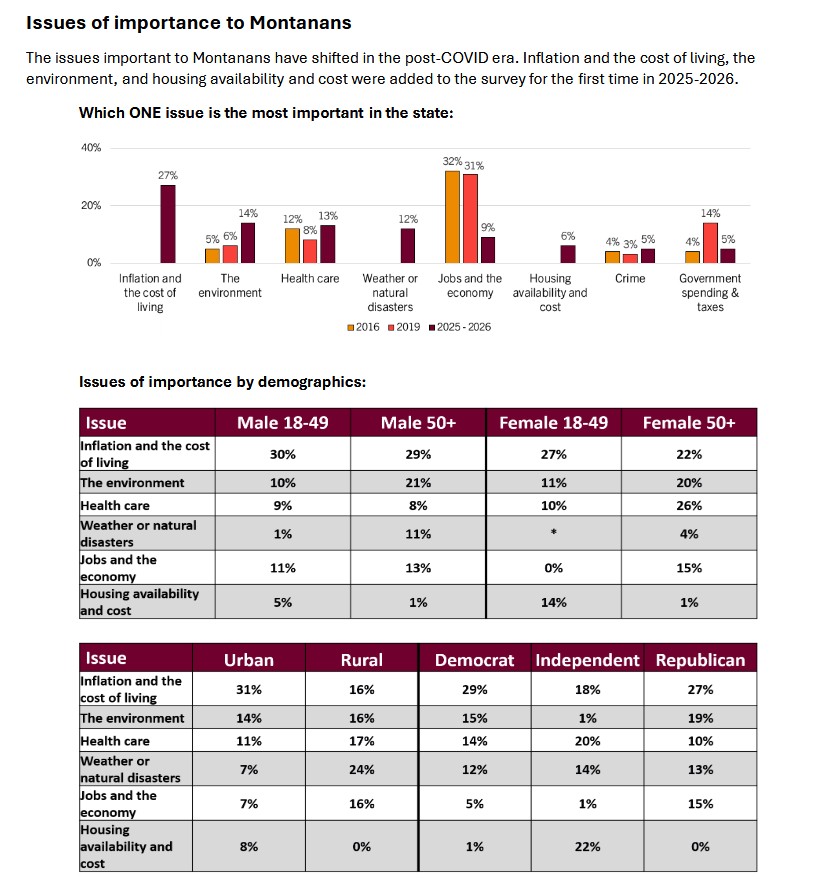
The study also asked Montanans about issues of importance. When asked which “one issue” respondents think is most important to Montana, inflation and the cost of living was by far the top concern for Montanans at 27%. Other top issues include (in order of importance) the environment, health care, weather or natural disasters, and jobs and the economy.
About the Greater Montana Foundation
Founded in 1958 by visionary pioneer broadcaster, entrepreneur and philanthropist Ed Craney, the Greater Montana Foundation aims to benefit the people of Montana by encouraging communication on the issues, trends and values important to present and future generations of Montanans. Through its grant program, GMF provides support to a broad range of television, radio and documentary film initiatives. GMF has been a longtime sponsor of Montana PBS and Montana Public Radio programming. Results from this survey will be used to provide focus areas for GMF grantmaking in the future. greatermontana.org
Methodology: The 2025-2026 Sources of News Survey was commissioned by the Greater Montana
Foundation and conducted and analyzed by the University of Montana Bureau of Business and Economic
Research with analytical assistance from Public Opinion Strategies, a national public opinion research firm.
BBER used leading-edge random, address-based sampling of adult Montana residents, with responses
collected by mail and internet. A total of 406 adults completed the survey between November 2025 and
February 2026. The results have a sampling error rate of +/- 6%. Other sources, such as question wording and
reporting inaccuracies, may contribute additional error. The survey estimates are weighted by sex, age,
education, tenure and Montana 2024 presidential election voting data from the U.S. Census Bureau and
Montana Secretary of State. Survey estimates for subgroups should be interpreted with care as they are based
on fewer respondents. Full question wording may be obtained from John Baldridge of UM BBER:
john.baldridge@umontana.umt.edu