By Jeffrey Michael
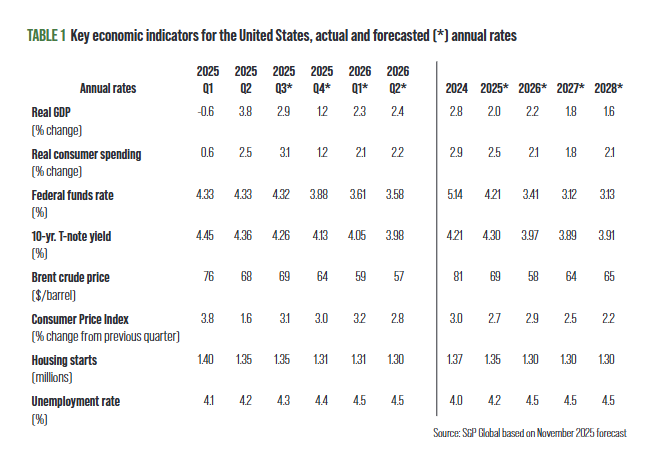
Looking through the trade volatility in the first half of the year, and the short-term data blackout in the second half of the year, the economy appears to be growing at a modest 1.5% to 2% rate for most of 2025.
The government shutdown may have ended a few weeks ago, but the economic outlook is still clouded by the resulting data blackout as this article is written in early December. Data that is normally critical to the outlook for the upcoming year, including third quarter GDP, jobs reports for October and November, and updated Census estimates are still unavailable. While this lack of data obscures the outlook, we have the benefit of a more stable economy with substantially reduced policy uncertainty compared to earlier in 2025.
In fact, the government shutdown has had less impact on the economy than its six-week duration would suggest. The deal to reopen included no changes to federal health care spending or policy, government jobs were preserved, and federal workers will get back pay. The shutdown impacts will reduce fourth quarter GDP, but for the most part, the economic impact is contained to a variety of delays and short-term inefficiencies that are insufficient to change the overall path of growth.
A year ago, the U.S. economic outlook for 2025 was foggy due to two sources of uncertainty: policy changes by the incoming Trump administration and the uncertain scale of the emerging AI boom. Both have delivered even bigger changes than anticipated.
Tariff Uncertainty Fades
The first half of 2025 was dominated by tariff news. Imports accelerated into the first quarter in anticipation of tariffs, and President Trump’s proposals were even bigger and bolder than anticipated. In April, this led to a steep drop in financial markets and fear of a global recession sparked by a global trade war if other countries retaliated with their own protectionist measures as anticipated. However, the president paused implementation of many tariffs through the summer, and most trading partners eventually chose not to retaliate and spark a mutually destructive trade war. While the worst-case scenario was avoided, U.S. tariffs remain at their highest level in nearly a century and are contributing to stubbornly high long-term interest rates, inflationary pressures, and disrupted business activity in impacted sectors.
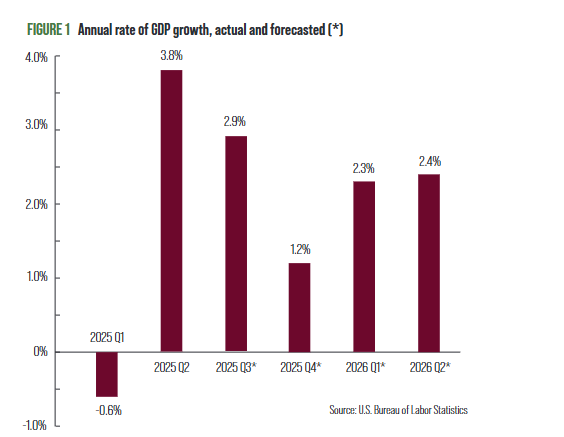
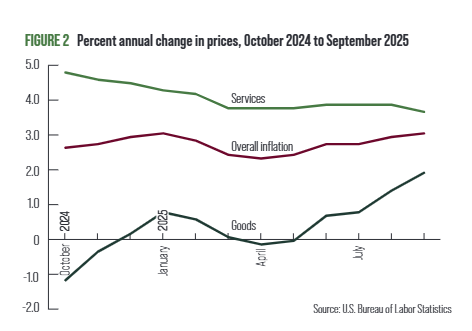
The early year surge in imports caused GDP to drop in the first quarter, followed by a rebound in the second quarter. Looking through the trade volatility in the first half of the year, and the short-term data blackout in the second half of the year, the economy appears to be growing at a modest 1.5% to 2% rate for most of 2025. Key indicators like housing starts and job growth have experienced slight declines in 2025 consistent with weak growth, but far short of recession. As tariffs start to impact the cost of imported goods, inflation has crept back up to 3% even as housing costs have stopped growing and gas prices have decreased.
Counteracting the tariff headwinds has been a massive surge in AI-related investment spending, including massive capital investments in structures and computing equipment as data centers are built around the country.
It is estimated that data center investment has boosted U.S. GDP growth by nearly 2 percentage points in 2025, accounting for most of current U.S. growth as many traditional types of business and residential investment and consumer spending are sluggish.
Looking Forward to 2026
Tariffs and AI will continue to be critical factors going forward. It appears that AI-driven investment spending will remain robust in the year. There is concern that AI-dependent tech stocks are overvalued and create a risk for a stock market correction and drop in investment. Whether AI is an investment bubble or the foundation for future economic growth will be a central question in the years to come.
Tariff headwinds are likely to decrease in 2026. The president has recently reduced tariffs for certain products like beef in response to affordability concerns, and this could expand to additional areas. In addition, the Supreme Court will rule soon on the legality of reciprocal tariffs, and it seems increasingly likely that the court could strike down roughly half of the tariffs implemented in 2025, especially those on consumer products. While the president will respond by expanding tariffs under other authorities, these have a slower and more deliberate process. Overall, tariffs should be somewhat lower and much more stable in the next year, which will reduce their negative impact.
There will also be some fiscal stimulus in 2026 as the tax cuts from the “One Big Beautiful Bill” start to hit household budgets. However, most of the spending cuts in the bill are postponed until 2027 or later. Even with these factors boosting the economy, economic growth is forecast to only inch up to 2.2% in 2026 and dip below 2% growth in 2027 and 2028. Weighing against growth in 2026 will be a housing market that continues to struggle with affordability issues that depresses residential investment, as well as slow hiring and stalled labor force and population growth as immigration drops sharply.
Jeffrey Michael is director at the Bureau of Business and Economic Research at the University of Montana.