By Terry Johnson
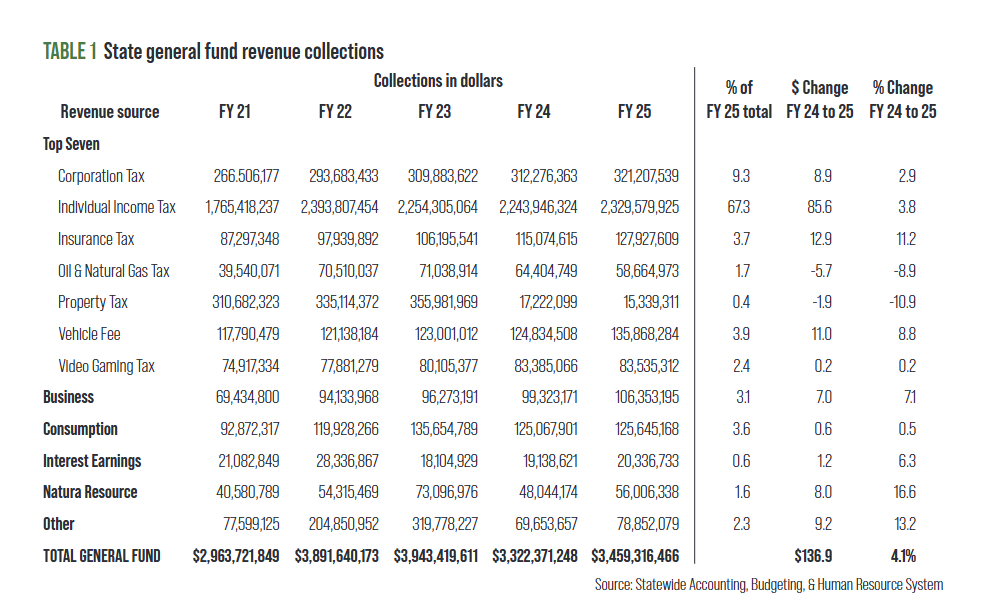
As shown in Table 1 for fiscal 2025, total general fund revenue collections were $3.46 billion with 77% collected from income (individual and corporation) taxes. These revenues are used to finance a variety of state services, but most of these funds are used for education, human service, and public safety programs.
Total general fund revenue collections increased by $136.9 million, or 4.1%, from collections received in fiscal 2024. This change was primarily due to increases in income taxes (individual and corporation, $94.5 million), insurance taxes ($12.9 million), and vehicle fees ($11 million) for a total increase of $118.4 million of the $136.9 million. The property tax decline observed since fiscal 2023 was due to legislative changes adopted by the 68th Legislature that redirected most of these revenues to a non-general fund account for support of public education. In addition, there is a non-general fund account called the budget stabilization reserve fund (BSRF). This fund is used to provide funding for the general fund account if revenue collections fall below expectations. The BSRF is funded from general fund monies that are above a specified amount at the end of each fiscal year. The BSRF, however, is capped at a certain amount. When this cap is reached, the excess is returned to the state general fund. This occurred in fiscal year 2022 ($115.1 million) and 2023 ($260.8 million) and is included as “Other Sources” revenue category shown in Table 1. There was no transfer of these monies in fiscal 2024 and 2025. Interest earnings sources declined from fiscal 2022 due to legislative changes to redirect some of these revenues to a non-general fund account. This redirection terminated at the end of fiscal 2025.
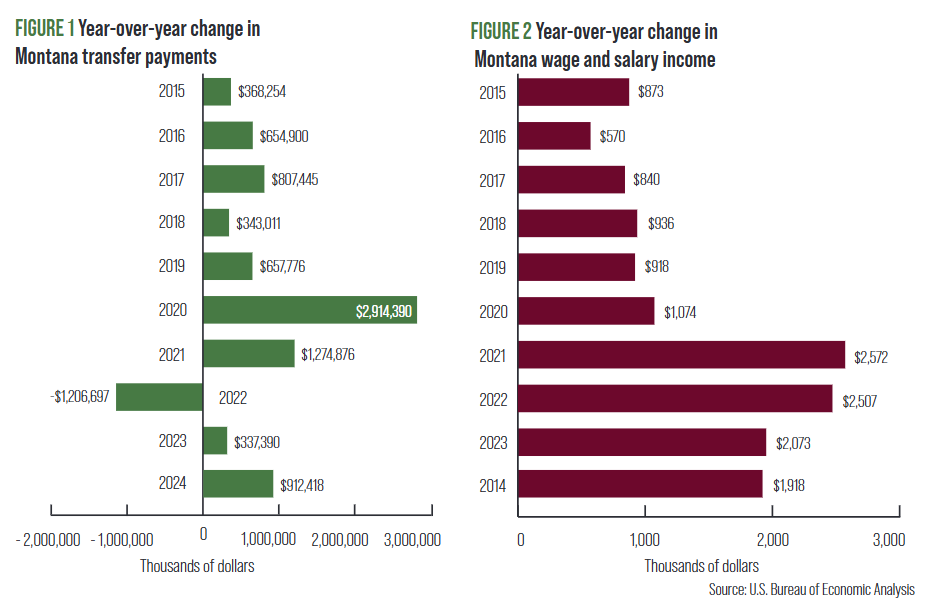
The changes in individual income tax collections since fiscal 2022 can be explained by federal legislation enacted to address the impacts of Covid-19. The federal stimulus payments enacted by Congress resulted in substantial payments to Montanans. The economic statistics maintained by the U.S. Bureau of Economic Analysis provide measures of transfer payments to Montanans as well as wage and salary income of employees. Figure 1 shows the year-over-year change in transfer payments since 2015. The amount of change increased by $2.9 billion from 2019 to 2020, a 27.4% increase with a further increase of $1.3 billion from 2020 to 2021 for a total increase of $4.1 billion over the two-year period. Once the stimulus payments were eliminated, transfer payments declined by $1.2 billion from 2021 to 2022. Transfer payments from 2022 to 2024 have now returned to a more normal growth pattern observed prior to 2020. Since these monies are considered taxable income under Montana law, income tax collections changed accordingly based on the tax liability of the taxpayer.
The pandemic also had an impact on the workforce available for Montana businesses. Throughout Montana there were numerous posted signs indicating businesses were searching for workers. This workforce demand increased the wage offerings of businesses. Higher wages increased total state wage and salary incomes as shown in Figure 2. Total wage income increased by $2.6 billion, or 10.9%, from 2020 to 2021 and $2.5 billion, or 9.4%, from 2021 to 2022. Wage growth from 2022 to 2024 has moderated but continues to be higher than historical trends prior to 2021. Higher wage income increased state individual income tax collections in fiscal 2022 but were diminished by the decline in transfer payments in calendar 2022. Individual income tax collections are expected to return to a more normal growth pattern after 2025, reflecting more normal growth rates for wages and transfer payments as well as taxpayer behavior payment patterns returning to historical trends.
Terry Johnson is the former chief revenue forecaster for the state of Montana. He is now retired.