Short-Term Rental Supply in Montana Faces Slower Growth Amid Policy Changes

By Brietta Russell

The short-term rental (STR) market in Montana has experienced impressive growth following the Covid pandemic. As travelers sought out low-density and high-amenity destinations, Montana homeowners responded to the surge in tourism by engaging in the STR market. Between December 2019 and December 2022, the total number of STRs listed on Airbnb or Vrbo increased from 14,000 to 18,000, and annual reservations in Montana increased from 245,000 to 373,000. However, growth in the market has begun to slow down. Rising home ownership costs, new property tax policies, and changing regulatory environments could play a role.

After three years of strong growth, the total supply of STRs has settled as fewer properties entered the market and more existing properties left. Growth in supply remained positive, but not all properties were available to be booked during each month. Hosts might block their listing’s availability for several reasons, often related to the primary use of the property. For instance, a dedicated vacation rental is more likely to be available than an additional living space in one’s home. Because of this, many listings become available in response to anticipated demand. The gap between total and available supply fluctuates with demand and has widened throughout the years, seen below.
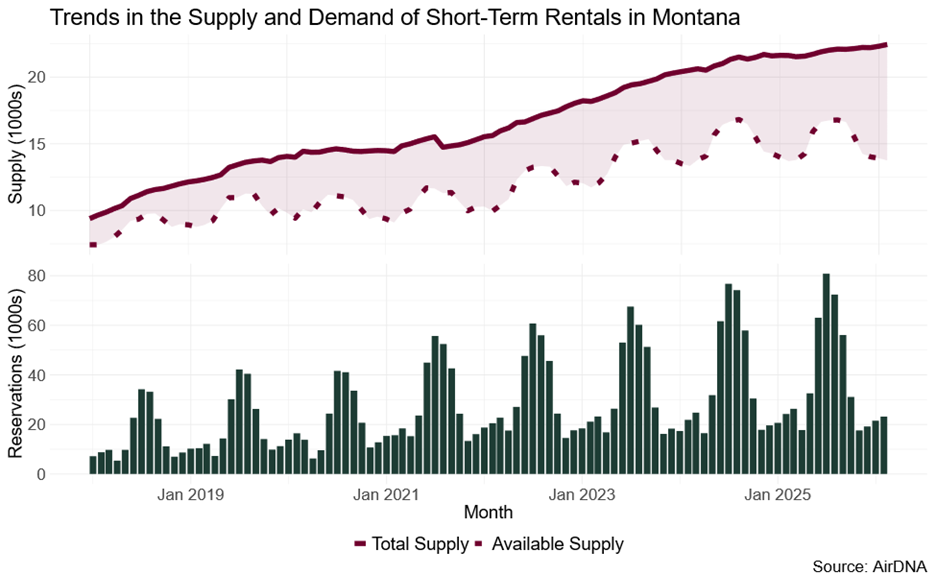
image 1

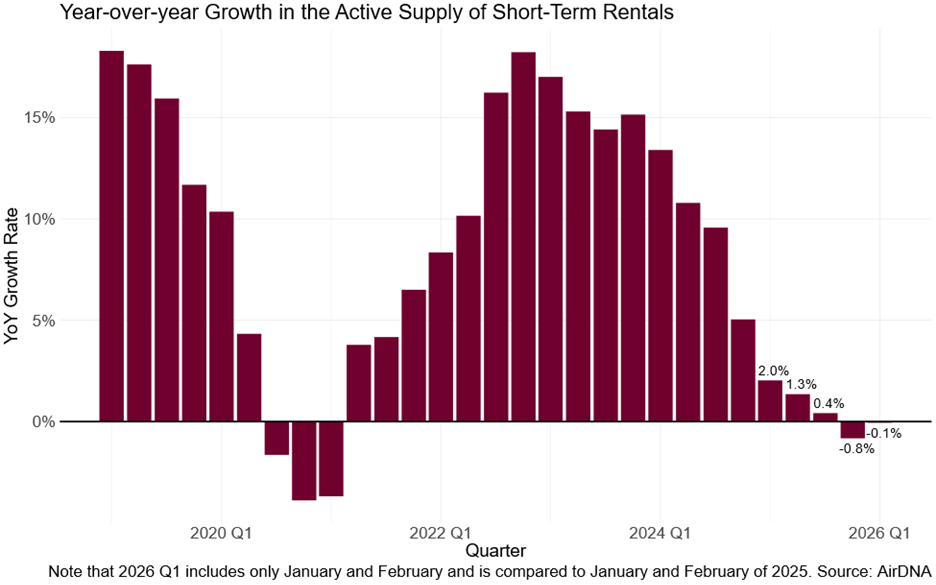
Year-over-year growth in available listings peaked at 18% in late 2022 and has since tapered off, as shown in the chart below. For the past five quarters, growth remained at or below 2%, and available supply declined in Q4 of 2025 for the first time since early 2021. This reduction could be capturing an anticipatory response to recent property tax legislation. The new statewide tax code took effect in 2026 and imposes a higher tax rate on properties not categorized as a primary residence or long-term rental. For some short-term rentals, the new tax rates will result in notable increases in their ownership costs.
image

It’s difficult to predict whether this trend will continue. Households with second homes may enter the short-term rental market to offset higher property tax bills. At the same time, existing short-term rentals could substitute toward the long-term rental market in pursuit of tax relief. Regulatory environments have also shifted – many cities have proposed or enacted STR regulations to limit the presence of dedicated vacation rentals. As local regulations and the new tax policy continue to evolve, we can expect to see changes in the composition of short-term rental supply.

More Articles
Recent Articles
Past Events

Midyear Economic Update 2026

A Midyear Assessment of the Outlook for the U.S. and Montana Economies with a Special Focus on High Tech, Data Centers, and the Digital Economy

2026 Economic Outlook Seminar

Thank you for attending the 2026 Economic Outlook Seminar held in 9 Montana cities from January 27 – March 11, 2026.

AUBER Conference

Thank you for attending the Association of University Business and Economic Research conference in Missoula, MT from October 4 – 7, 2025, hosted by the University of Montana Bureau of Business and Economic Research.

Diesel Fuel Shock Disproportionately Impacts Montana Households

By Jeffrey Michael

The diesel fuel shock hitting the nation is impacting many Montana households extra hard. In fact, some Montanans are talking about leaving their diesel trucks in the garage and driving gas vehicles.

U.S. Department of Commerce data reveals that Montanans spend 27% more per capita on motor vehicle fuels than the average American, and as a result, gas prices are causing 27% more pain to the average Montana household than nationally (see BBER article on disproportionate gas prices here)

Gas prices continue to remain high, but now diesel prices have spiked even higher, exceeding $6 per gallon across the state.  And that is making the pain in our state even worse because Montanans have much higher reliance on diesel vehicles. Diesel vehicles perform well in rural, mountain environments, making them a practical option in places like Montana and Wyoming where they are most common.

Montana ranks #2 in the nation for diesel vehicle concentration at 10.9% of light-vehicle registrations – which includes passenger vehicles and most pickup trucks – ranking only behind Wyoming, and over three times higher than the U.S. average of 3.3% diesel vehicles, according to BBER calculations of U.S. Energy Information Administration data.

Looking at so-called medium-duty and heavy-duty vehicles, the majority of which are diesel, shows that 12.3% of total vehicles in Montana are medium/heavy duty vs. 6.2% nationally, making the concentration of medium/heavy duty vehicles about double the national average.

Another measure of diesel intensity of the economy is diesel consumption per dollar of GDP. For this measure, we have to look at distillate fuels consumption, which includes diesel fuel for transportation and related products used for home heating and industrial uses. By this measure, Montana ranks 8th highest. While still very high, Montana is a little lower in this ranking. A few states moved ahead of Montana, including the states with very high industrial use of distillate fuels or those that commonly use distillate oil to heat homes and buildings (Maine), or have lower GDP per capita (Mississippi). See related article here.

By any measure, the diesel shock is tough on Montana households. While people driving diesel vehicles sometimes ponder switching to gas vehicles, not everyone has the ability to do that – especially those who need trucks to make a living. And this definitely hits rural Montana more than larger, urban cities in the state since reliance on diesel trucks for work and rural life is higher.