Rising Gas Prices Disproportionately Impact Montanans

By Jeffrey Michael

When gas prices rise suddenly, consumers are negatively impacted while some producers benefit. Starting in March, gasoline prices have steeply increased as a result of rising global oil prices since the onset of the war with Iran. Montanans spend a lot of money on gasoline and diesel as geography and lifestyle requires us to travel longer distances and drive larger vehicles. In fact, the most recent data on consumer expenditures show that Montanans spend 27% more per capita than the average American on motor vehicle fuels.
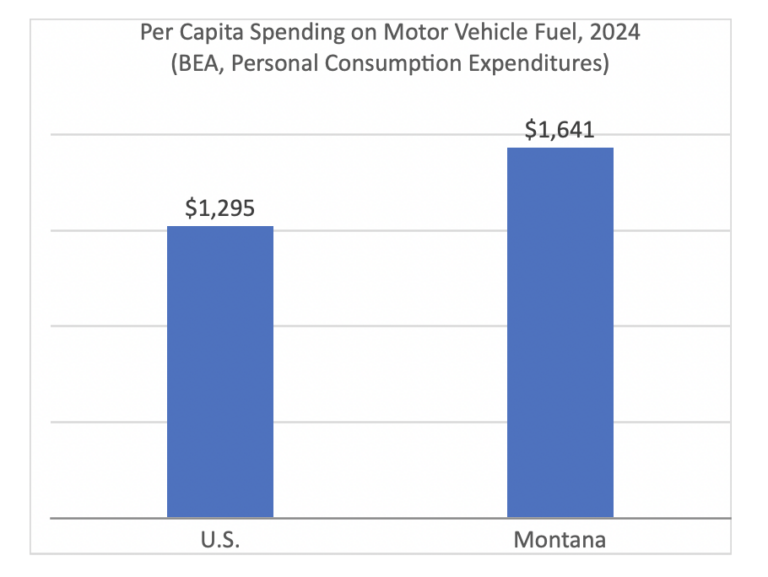
image 9

In 2024, regular gas prices averaged $3.30 per gallon nationwide. The current average is just over $4 per gallon. If fuel prices stay near their current level for the rest of the year, Montanans would spend about $2,000 per capita on fuel in 2026, about $350 more than they did in 2024.  Larger households and those who drive more could see thousands of dollars in additional costs. In the near term, it may feel as if the increase is even larger as average gas prices were $3 or below this winter before the recent increase following the Iran War and disruption of oil shipments from the Persian Gulf. These fuel costs will also impact key Montana industries like agriculture – where oil prices impact production costs – and tourism since the majority of Montana visitors drive to our state and they may be less likely to drive here on vacation or spend less when they arrive as a result.

Not all Montanans are harmed, though, as Montana is an oil-production state as well.  Overall, Montana ranked 11th in the nation in crude oil production in 2025, although Montana’s contribution to overall U.S. output is modest, less than 1% of total U.S. output. Texas is nearly half of U.S. production and Montana lags behind neighboring North Dakota and Wyoming. In 2024, oil and gas extraction made a direct contribution of $576 million to the state’s GDP, about 0.7% of the $78.4 billion total. In 2013-14 during the Bakken boom, oil and gas extraction was nearly 2% of state GDP, roughly 2.5 times current levels. Rising oil prices have the potential to spur Montana production to higher levels.  As shown in the graph below, new permits for oil production surged in the 1st quarter of 2024 to the highest level since 2014.  It’s too early to tell if there will be a sustained increase in oil production in Montana, but it has the potential to at least partially offset the considerable pain higher fuel prices are causing for the state’s economy.
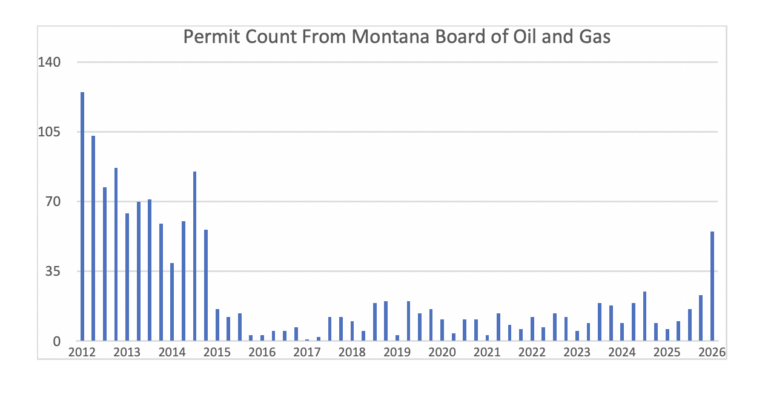
image 8
More Articles
Recent Articles
Past Events

Midyear Economic Update 2026

A Midyear Assessment of the Outlook for the U.S. and Montana Economies with a Special Focus on High Tech, Data Centers, and the Digital Economy

2026 Economic Outlook Seminar

Thank you for attending the 2026 Economic Outlook Seminar held in 9 Montana cities from January 27 – March 11, 2026.

AUBER Conference

Thank you for attending the Association of University Business and Economic Research conference in Missoula, MT from October 4 – 7, 2025, hosted by the University of Montana Bureau of Business and Economic Research.

Diesel Fuel Shock Disproportionately Impacts Montana Households

By Jeffrey Michael

The diesel fuel shock hitting the nation is impacting many Montana households extra hard. In fact, some Montanans are talking about leaving their diesel trucks in the garage and driving gas vehicles.

U.S. Department of Commerce data reveals that Montanans spend 27% more per capita on motor vehicle fuels than the average American, and as a result, gas prices are causing 27% more pain to the average Montana household than nationally (see BBER article on disproportionate gas prices here)

Gas prices continue to remain high, but now diesel prices have spiked even higher, exceeding $6 per gallon across the state.  And that is making the pain in our state even worse because Montanans have much higher reliance on diesel vehicles. Diesel vehicles perform well in rural, mountain environments, making them a practical option in places like Montana and Wyoming where they are most common.

Montana ranks #2 in the nation for diesel vehicle concentration at 10.9% of light-vehicle registrations – which includes passenger vehicles and most pickup trucks – ranking only behind Wyoming, and over three times higher than the U.S. average of 3.3% diesel vehicles, according to BBER calculations of U.S. Energy Information Administration data.

Looking at so-called medium-duty and heavy-duty vehicles, the majority of which are diesel, shows that 12.3% of total vehicles in Montana are medium/heavy duty vs. 6.2% nationally, making the concentration of medium/heavy duty vehicles about double the national average.

Another measure of diesel intensity of the economy is diesel consumption per dollar of GDP. For this measure, we have to look at distillate fuels consumption, which includes diesel fuel for transportation and related products used for home heating and industrial uses. By this measure, Montana ranks 8th highest. While still very high, Montana is a little lower in this ranking. A few states moved ahead of Montana, including the states with very high industrial use of distillate fuels or those that commonly use distillate oil to heat homes and buildings (Maine), or have lower GDP per capita (Mississippi). See related article here.

By any measure, the diesel shock is tough on Montana households. While people driving diesel vehicles sometimes ponder switching to gas vehicles, not everyone has the ability to do that – especially those who need trucks to make a living. And this definitely hits rural Montana more than larger, urban cities in the state since reliance on diesel trucks for work and rural life is higher.